Tuesday, 16 July 2013

Irish Heritage Group, 3 July

Sarah and I spent the evening of 3 July at the Irish Club, Digbeth High Street for a Birmingham Irish Heritage Group meeting and lecture. We were kindly invited along by Jim Ranahan with the support of Ann at the Irish Heritage Group.


Jim gave a really interesting talk entitled 'How do we want to be remembered? Community involvement with Birmingham museums', which stimulated a lot of discussion afterwards about representation of a collective heritage and community engagement. We were delighted that Jim used our project as an example of the ways in which the community could tell their own stories and gain wider representation in the archive.


Following Jim's lecture, we spoke to the group about our project. We received a warm welcome and enjoyed talking to several members of the community afterwards; they each had fascinating stories to share about life in Digbeth, past and present.

Sarah and me with Jim and Ann


It was an insightful evening and we are looking forward to interviewing Jim and two members of the group - who we met on the night - over the coming weeks.

Carly Hegenbarth, Project Manager

Sunday, 7 July 2013

Pubs of Digbeth walk, 29 June

On Saturday 29 June we co-hosted the RIBA (Royal Institute of British Architects) Love Architecture Pubs tour of Digbeth. It was led by architect and urban designer, Joe Holyoak and we were joined by people interested in architecture, Digbeth and, crucially, pubs...

We started at The Woodman by Millennium Point which has recently been granted planning permission for renovations and to be reopened. The architecture was by James and Lister Lea who were responsible for designing a number of pubs in the Digbeth area during the late nineteenth century – they’re easy to spot by their red bricks and terracotta decorations. The next pub, also a James and Lister Lea, was the Eagle and Tun. Now boarded up, it was once frequented by UB40 whose recording studios were just round the corner – the interior features in the video for Red Red Wine and there’s an article about it here.


At one time there was a pub on virtually every other street in Digbeth; we learnt that they were mostly on street corners in order to maximise passing trade. Some were purpose-built as public houses and others were converted from domestic buildings, such as the ex-Spotted Dog on Meriden Street.

On the tour, we also passed other pubs no longer in operation such as The Old Wharf on Coventry Street, which was known for its Heavy Metal clientele and gigs and only closed in recent years. I went there a couple of years ago (and it was Metal) so that must have been very soon before it closed. It had a small stage in the gig room and the whole interior back room was painted with images of bands from through the ages.

After The Old Wharf, we passed the Birmingham Packpackers. This ex-pub on the corner of Coventry Street was built in the 1920s and is of a notably different style to the grand James and Lister Lea pubs. At the start of the twentieth century there was increasing concern about drinking and pub environments - as such, new pubs were built in a more domestic style. The Spotted Dog on Alcester Street is another pub that would appear to fit this style.


Towards the end of the walk we went into The Anchor and The White Swan on Bradford Street to see the interiors; both are James and Lister Lea and are definitely worth a visit. The White Swan still has its original Minton tiles and both pubs retain much of their original character.


We ended in The Old Crown which archaeological investigations date to the late fifteenth century - so, far more ancient than the other architecture we’d already seen. The building began life as the Guildhall and School of the Guild of St John the Baptist of Deritend (the church of St Johns used to stand on the other side of the road) and didn’t become a pub until the nineteenth century. The building has a long and fascinating history which is well worth investigating, including that it was used as a safe house during the English Civil War.

Some fascinating themes emerged from the histories of these pubs and the people who we spoke to on the walk. Firstly, and in contrast to now, pre-Second World War, Digbeth was a densely populated area with terraces, back-to-back housing and factories crammed in with a multitude of pubs serving the community. Now many of these pubs have gone but their traces can still be seen on street corners throughout modern-day Digbeth. Another consistent theme is the sometimes difficult dynamic between residents and pubs, particularly music venues of which there have historically been a lot in Digbeth. Noise complaints have frequently threatened the survival of pubs - The Rainbow on Adderley Street had a very narrow escape from closure a couple of years ago, and The Spotted Dog with its legendary Jazz and Irish music nights has been more recently threatened. The industrial nature of the area was commented on by our fellow walkers, as well as the fact that many of them hadn’t been into the pubs here before but that they certainly would again.

All in all, we had a fantastic day and spoke to some great people - this was thanks to everyone on the tour, the pubs of Digbeth and a few pints along the way! The message is: go and explore Digbeth’s great pub heritage!


For anyone interested in finding out more, Joe Holyoak has highly recommended the following books: Birmingham Pubs 1880-1939 by Alan Crawford, Michael Dunn and Robert Thorne; the Birmingham edition of Pevsner Architectural Guides to Birmingham; CAMRA’s Britain’s Best Real Heritage Pubs, Pub Interiors of Outstanding Historic Interest by Geoff Brandwood.  The Midlands Pubs website is also an excellent source of information on Birmingham’s pubs.

Katie Hall

Volunteer social

On Tuesday last week we hosted a great social for all our volunteers as a thank you for all their ongoing hard work and to celebrate our achievements so far. It was lovely to get the team together and chat about the project, including experiences of doing oral histories and vox pops, as well as times spent in Digbeth. Thanks everyone!!

We also had the chance to update everyone about what we’ve achieved so far, and talk about the exciting things still to come, particularly the exhibition that’ll mark the end of the project which we’ve now confirmed will be at the Custard Factory. It’ll be fantastic to share everything we’ve gathered about Digbeth over the past few months.

Watch this space…..


Katie Hall

Wednesday, 19 June 2013

Lights, camera, action


The Digbeth Speaks team were also at the Custard Factory event on 8 June, as featured in the blog post below, but this time we were recording the sounds of Digbeth in a different form -  the lovely duo Hassan and Anni were busy filming us and the event!

Watch this space; we'll post the short film here as soon as it's ready!


Vintage, BBQ and Abseil galore

On Saturday 8 June, The Custard Factory just off the Digbeth High Street played host to ‘The Vintage Fair’ . For those who weren’t there - you missed out. Blessed with glorious sunshine and the tantalising smell of BBQ, I spent the day wandering around the stalls, which were a mixture of car boot and professional sellers, each packed with unique and quirky treasures. Needless to say my bank balance took a substantial hit.


After taking in as much antique furniture and vintage clothing as I could, with my friend, I headed to ‘yumm’ café where I purchased a warm wrap of mixed salad with some form of grilled cheese which came from Syria whose name I honestly couldn’t tell you (it may be useful to note that if you spend over a fiver here they allow you to have up to £50 cash back, saving you the £1.50 fee the cash machine the spa charges). We took our food to the only spot in which to be seen eating lunch on a sunny day at the Custard Factory - the large pool in the centre of the courtyard which sometimes (albeit rarely) has its fountain running - try finding a lunch spot like this in the Bullring!


The wrap, although very good, couldn’t exactly eliminate the longing I felt for the BBQ which was wafting its scent around the place. Next time I’m definitely going with the BBQ! (The pool is also a fabulous place to sooth hot and shopped-out feet!)


Apart from shopping, vintage, and BBQ’s, there was a lovely busker, a terrifying abseiling opportunity over the edge of one of the Custard Factory’s buildings for Acorn's Hospice and a rally of vintage motorcycles to entice the crowds. It was a perfect way to spend a summer Saturday, and I certainly recommend that you make it your mission to get yourself down to the next one which is on 3rd August.


Guest post written by Maysie Chandler, Oral History Interviewee
Photos courtesy of M Chandler


'A Small Hiccup' exhibition and 3rd birthday, Grand Union, 24 May


On Friday 24th May, a group of us, comprising Marie, Sarah, Hamish, Nikolay (our trusty photographer) and I, attended the opening of 'A Small Hiccup', at Grand Union, Minerva Works. The gallery was also celebrating its third birthday. 


Grand Union is both a gallery and studio space in Digbeth, which is run by, and supports, artists and curators. ‘A Small Hiccup’ is their latest exhibition. Running from 25 May to 5 July, it showcases artists’ responses to diseased language. We were fortunate to be able to attend the opening, hear the introductory speeches and then peruse the new exhibition (the enticing samosas provided were an added bonus).  In addition, we were able to view the eight studios of local contemporary artists that also occupy the space, which gave us the opportunity to be able to see the artists in their studio setting and witness the new, exciting art that they are each working on. We were able to discuss with the artists their inspirations, aspirations, techniques and mediums they are experimenting with in their art. We had a fascinating discussion with artist Harminder Judge about the research he is undertaking for his latest project.

Whilst at the exhibition we found plenty of people willing to be vox popped, some of whom were the artists themselves. Visitors to the exhibition, both those that live locally and regularly attend events in Digbeth, and individuals who had travelled specifically to attend the event and were thus experiencing the area for the first time, also shared their impressions of Digbeth with us. All in all, we were grateful to be able to record the diverse and stimulating perspectives of the artistic community that seems to be thriving in Digbeth.

Hannah Squire, Project Volunteer

MSFAC exhibition launch, 17 May


Margaret Street Free Arts Council (MSFAC) is a punk art collective currently based at the Edge, Cheapside. Since its formation at Margaret Street School of Art, it has been gaining strength and ferocity in its attack on political and social evils. MSFAC promotes free art that involves the grass root level disillusioned with 'Democracy'. Amongst their many creative outputs is the newspaper Distrakshun Press, as well as free head shaving, printmaking, ukulele-making workshops in solidarity with punk and anarchist movements.
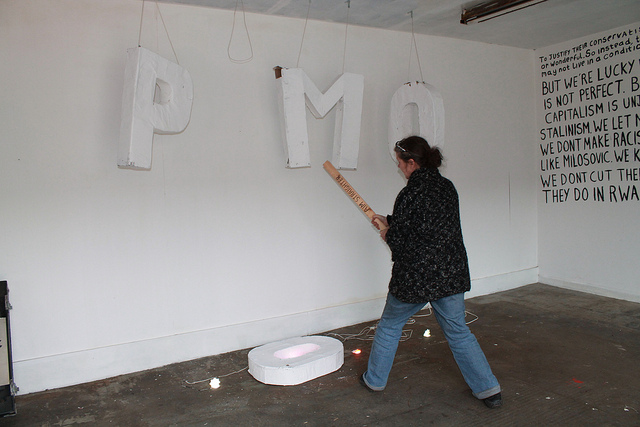
For the Digbeth gallery late opening on 17 May, MSFAC launched their new exhibition in collaboration with Dan Salisbury. In their signature hand-made fashion, hand-painted wall texts and placards made sarcastic remarks on Captialist Realism, quoting the likes of Frederic Jameson and Mark Fisher. On the ceiling hung the cardboard piñatas depicting the word 'POMO', next to them were a set of bats, tempting the audience to take charge and destroy 'Postmodernism'. By the end of the exhibition, the piñatas were shredded to pieces, achieving the artists' purpose to remove the demarcation between 'art' and 'protest'.


Having talked to Amy, Niall and Matt, founders of MSFAC, I can't help but to admire their genuine commitment, their insight into thetheoretical and practical implication of their activities. As they have declared on their blog, MSFAC is a rebellious 'council of working artists' that aims to one day overthrow the 'market obsessed government art council'.


Tessa Mo, Project Volunteer